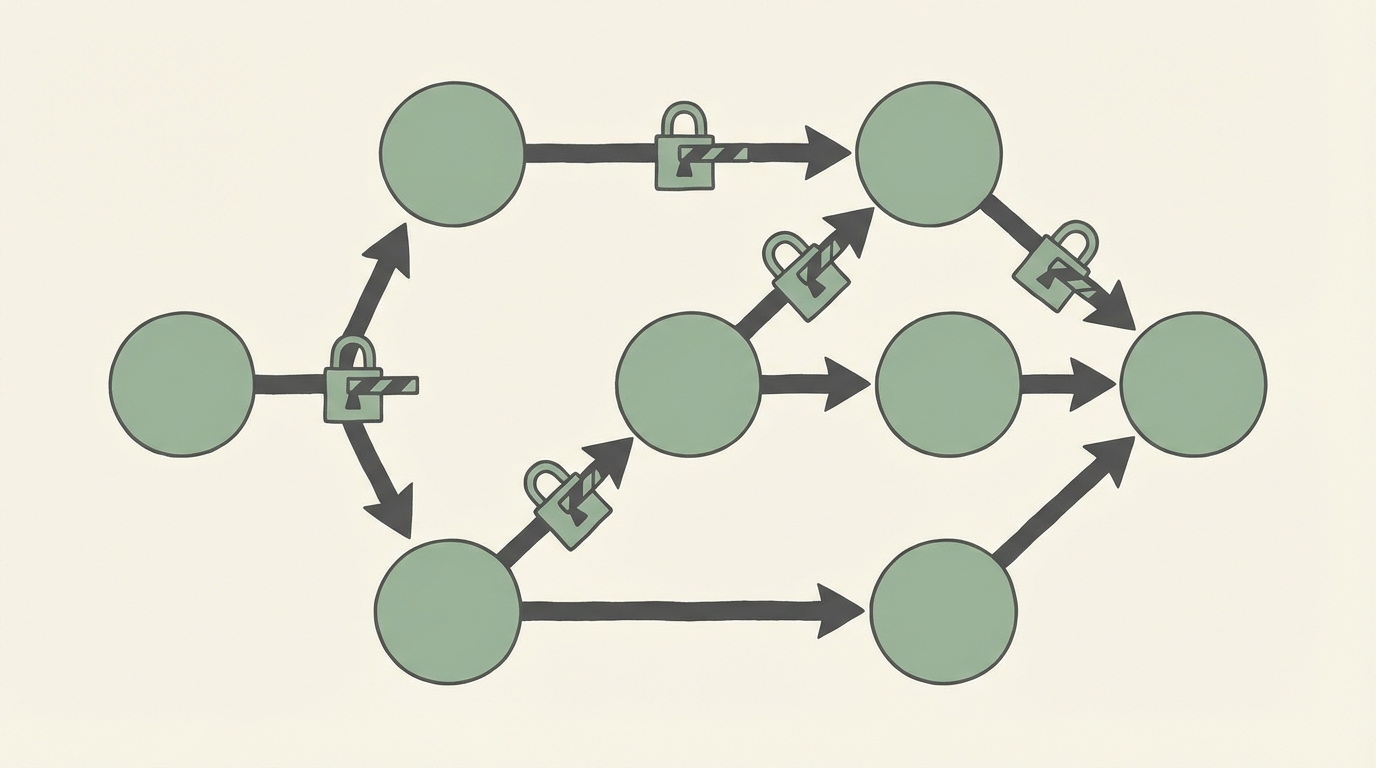
You have a LangGraph agent in production. It works. It chains tool calls, manages state across graph nodes, and handles the routing logic your team designed. Now someone — a compliance officer, a security lead, a VP who read an article about the EU AI Act — wants governance. Audit logs. Policy enforcement. Decision records that can survive a regulatory inquiry.
The instinct is to rewrite. Open the graph definition, add policy checks inside every node, sprinkle logging into every transition. This instinct is wrong. It couples governance logic to orchestration logic in a way that makes both harder to change, harder to test, and harder to audit independently. Worse, it means every future change to the graph must also consider governance implications, and every governance change must be coordinated with an engineering deployment.
There is a better approach: treat governance as an external layer that intercepts, evaluates, and records agent decisions at well-defined boundaries — without modifying the graph's internal logic. This article describes three integration patterns for doing exactly that, ranked by invasiveness and implementation effort. Each pattern assumes you are familiar with the propose-then-decide architecture and have a working LangGraph deployment. The goal is to add governance without rewriting what already works.
Why Governance Should Be Framework-Agnostic
Before discussing LangGraph-specific patterns, it is worth establishing a principle: governance logic should not be tightly coupled to any orchestration framework. The reason is lifecycle mismatch. Your orchestration framework — LangGraph today, possibly something else in 18 months — changes on an engineering cadence. Your governance requirements change on a regulatory and compliance cadence. These two cadences are not synchronized, and coupling them creates operational friction.
A governance layer that is embedded in LangGraph graph nodes must be updated when the graph changes. A governance layer that sits at the boundary between the graph and the outside world — intercepting tool calls, evaluating decisions, recording traces — can be updated independently. This is the same separation-of-concerns argument that drives the OPA sidecar pattern in infrastructure policy: decouple policy evaluation from the system being governed.
The practical test: can you change a governance rule without redeploying the agent? Can you change the agent's graph structure without invalidating your governance configuration? If either answer is no, governance and orchestration are too tightly coupled.
Where Governance Intercepts: The Tool Call Boundary
In any LLM-based agent system — LangGraph, OpenAI Agents SDK, CrewAI, or a custom implementation — the natural governance boundary is the tool call. This is the point where the agent transitions from "thinking" (model inference) to "acting" (executing a function that affects the outside world). The OpenAI function calling schema makes this boundary explicit: the model proposes a function call with structured arguments, and the runtime decides whether to execute it.
LangGraph implements this boundary through tool nodes — graph nodes that wrap function execution. When the LLM proposes a tool call, the graph routes to the tool node, which executes the function and returns the result. This is the interception point. Governance logic belongs here: after the model proposes an action and before the system executes it.
There are three places you might be tempted to put governance logic instead. All three are worse:
- Inside the LLM prompt: Non-deterministic, untestable, unversioned, and invisible to auditors. The model may or may not follow the instruction. This is a suggestion, not a constraint.
- Inside graph routing logic: Couples governance to orchestration. Every graph change potentially affects governance behavior. Rule changes require engineering deployments.
- After execution: Too late. Governance evaluated after the tool has already fired is detection, not prevention. You need both, but prevention requires pre-execution evaluation.
Pattern 1: Decision Gate Middleware
What It Is
A decision gate is a wrapper around LangGraph's tool execution that intercepts every tool call, evaluates it against a governance policy, and either permits, denies, or modifies the call before execution. It is the most direct integration pattern and the one that provides synchronous enforcement — no tool call executes without passing through the gate.
How It Works in LangGraph
LangGraph allows you to define custom tool executors — functions that wrap the actual tool implementation. The decision gate replaces the default executor with a governance-aware wrapper:
# Pseudocode: Decision gate middleware for LangGraph tool nodes

def governance_gate(tool_call, context):
    """
    Intercepts a tool call before execution.
    Evaluates against governance policy.
    Returns: permitted call, modified call, or denial.
    """
    # 1. Extract structured decision inputs
    decision_request = {
        "agent_id": context.agent_identity,
        "tool_name": tool_call.name,
        "arguments": tool_call.arguments,
        "session_id": context.session_id,
        "timestamp": now_utc()
    }

    # 2. Evaluate against external policy engine
    decision = policy_engine.evaluate(decision_request)

    # 3. Record the decision trace (regardless of outcome)
    trace_store.append({
        "trace_id": generate_uuid(),
        "request": decision_request,
        "policy_version": decision.policy_version,
        "rules_evaluated": decision.rules_evaluated,
        "outcome": decision.outcome,
        "timestamp": decision_request["timestamp"]
    })

    # 4. Enforce the decision
    if decision.outcome == "deny":
        return ToolDenied(reason=decision.reason)
    elif decision.outcome == "modify":
        tool_call.arguments = decision.modified_arguments
        return execute_tool(tool_call)
    else:
        return execute_tool(tool_call)


# Integration: wrap existing tool nodes
def wrap_tool_node(original_tool):
    def governed_tool(tool_call, context):
        return governance_gate(tool_call, context)
    return governed_tool
What This Pattern Gives You
- Synchronous enforcement: No tool call bypasses the gate. Denied actions never execute.
- Automatic trace generation: Every tool call — permitted, denied, or modified — generates a decision trace.
- Framework-decoupled policy: The governance logic lives in the policy engine, not in the graph definition. Policy changes do not require graph redeployment.
What to Watch For
Latency. A synchronous policy evaluation adds latency to every tool call. For simple policies evaluated locally (in-process OPA, for instance), this is typically sub-millisecond. For policies that require external service calls — checking a user's authorization against a remote identity provider, for instance — latency can be significant. Measure before deploying.
Failure mode design matters. If the policy engine is unreachable, should the tool call proceed (fail open) or be denied (fail closed)? For consequential actions, fail closed is almost always correct. For read-only informational tool calls, fail open may be acceptable. Define this per tool category, not globally.
Pattern 2: Policy Sidecar for Asynchronous Evaluation
What It Is
A policy sidecar is a separate process — co-located with the agent runtime but independently deployable — that evaluates governance policies asynchronously. Unlike the decision gate, the sidecar does not block tool execution. Instead, it receives a copy of every tool call event, evaluates it against policy, and takes action if violations are detected: flagging for human review, triggering alerts, or recording governance events for audit.
When to Use It Instead of a Decision Gate
The sidecar pattern is appropriate in two situations. First, when latency requirements make synchronous evaluation infeasible — real-time agent interactions where even 10ms of added latency degrades user experience. Second, when you are introducing governance incrementally and want to observe before enforcing. Running the sidecar in observation mode for two to four weeks before enabling enforcement gives your team data on what the policy would have blocked, allowing you to tune rules before they affect production.
Architecture
# Sidecar architecture for asynchronous governance evaluation

Agent Runtime (LangGraph)
  |
  |-- [tool call event emitted] --> Event Bus (Kafka / SQS / Redis Streams)
  |                                       |
  |                                       v
  |                              Policy Sidecar Process
  |                                |
  |                                |-- Evaluate against policy engine
  |                                |-- Record governance trace
  |                                |-- If violation detected:
  |                                |     |-- Flag for human review
  |                                |     |-- Emit alert
  |                                |     |-- (Optional) Request agent pause
  |                                |
  v
  [tool executes normally]
The sidecar pattern follows the same architectural principle as the OPA sidecar model used in Kubernetes policy enforcement: co-locate the policy evaluator with the workload, communicate over a lightweight protocol, and keep the policy lifecycle independent of the application lifecycle.
The Observation-to-Enforcement Upgrade Path
The most practical deployment sequence is:
- Week 1-2: Observation only. The sidecar receives all tool call events, evaluates policies, records results, but takes no enforcement action. You are collecting data on what governance would look like.
- Week 3-4: Alert mode. The sidecar flags policy violations to a human review queue. Violations do not block execution, but someone is notified.
- Week 5+: Selective enforcement. For specific high-risk tool categories (financial transactions, data deletions, external API calls), the sidecar upgrades to synchronous enforcement using Pattern 1. Low-risk tool calls remain in observation or alert mode.
This gradual path means governance never arrives as a sudden enforcement event that breaks existing workflows. Teams can see what would have been blocked before anything actually is.
Pattern 3: Trace Exporter for Audit-Grade Logging
What It Is
A trace exporter is the minimal governance integration: it does not evaluate policy or enforce decisions. It captures every tool call, every agent state transition, and every model proposal in a structured, append-only format that satisfies audit requirements. This is governance through visibility — making every decision reconstructable, even if no policy enforcement is in place yet.
Why This Is Sometimes the Right First Step
Teams that need governance evidence for an upcoming audit but cannot afford the engineering effort of a full policy enforcement layer should start here. A trace exporter can be implemented in hours, not weeks, and it solves the most common audit failure mode: the inability to answer "what did the system do and why?" for a specific past event.
Implementation with LangGraph Callbacks
LangGraph supports callback handlers that receive events at every graph transition. A trace exporter hooks into these callbacks to capture a structured record of every significant event:
# Trace exporter using LangGraph callback handlers

class GovernanceTraceExporter:
    def __init__(self, trace_store):
        self.trace_store = trace_store

    def on_tool_start(self, tool_name, arguments, run_id, **kwargs):
        self.trace_store.append({
            "event_type": "tool_call_proposed",
            "trace_id": run_id,
            "tool_name": tool_name,
            "arguments": self._sanitize(arguments),
            "agent_id": kwargs.get("agent_id"),
            "timestamp": now_utc(),
            "schema_version": "1.0.0"
        })

    def on_tool_end(self, output, run_id, **kwargs):
        self.trace_store.append({
            "event_type": "tool_call_completed",
            "trace_id": run_id,
            "output_summary": self._summarize(output),
            "timestamp": now_utc(),
            "schema_version": "1.0.0"
        })

    def on_tool_error(self, error, run_id, **kwargs):
        self.trace_store.append({
            "event_type": "tool_call_failed",
            "trace_id": run_id,
            "error": str(error),
            "timestamp": now_utc(),
            "schema_version": "1.0.0"
        })

    def _sanitize(self, arguments):
        # Remove PII, redact sensitive fields
        return redact_sensitive_fields(arguments)

    def _summarize(self, output):
        # Capture outcome without storing raw model output
        return truncate_and_structure(output)
What This Pattern Does Not Do
A trace exporter does not prevent anything. It does not enforce policy. It does not deny tool calls or modify arguments. If your requirement is "no agent should be able to delete customer data without human approval," a trace exporter will tell you after the fact that the deletion happened, but it will not prevent it. For enforcement, you need Pattern 1 or Pattern 2. The trace exporter is a foundation — necessary but not sufficient for full governance.
Comparing the Three Patterns
| Property | Decision Gate (Pattern 1) | Policy Sidecar (Pattern 2) | Trace Exporter (Pattern 3) |
|---|---|---|---|
| Enforcement | Synchronous (blocks execution) | Asynchronous (flags/alerts post-execution) | None (logging only) |
| Latency Impact | Per-call evaluation latency | Minimal (async processing) | Minimal (append-only write) |
| Implementation Effort | Medium (tool executor wrapping + policy engine) | Medium-High (event bus + sidecar process) | Low (callback handler only) |
| Graph Modification Required | Minimal (swap tool executors) | None (event emission only) | None (callback attachment only) |
| Audit Sufficiency | Full (decision + enforcement records) | Full (decision records, delayed enforcement) | Partial (action records, no decision rationale) |
| Best For | High-risk actions requiring prevention | Gradual rollout; latency-sensitive systems | Audit preparation; first governance step |
Most production deployments will use a combination. Pattern 3 as a baseline for all tool calls. Pattern 1 for the three to five highest-risk tool categories. Pattern 2 for everything in between, as a stepping stone toward selective enforcement based on observed policy violation patterns.
What to Avoid: Hard-Coding Policy Into Graph Nodes
The pattern to actively resist is embedding governance checks directly into LangGraph graph node logic. It looks like this:
# Anti-pattern: governance logic embedded in graph node

def process_refund_node(state):
    # Business logic
    refund_amount = calculate_refund(state["order"])

    # Governance check embedded directly in the node
    if refund_amount > 500:
        if not state.get("manager_approved"):
            return {"action": "escalate", "reason": "refund exceeds $500"}

    # More governance logic
    if state["customer"]["region"] == "EU":
        log_gdpr_decision(state)

    return {"action": "process_refund", "amount": refund_amount}
This pattern has four concrete problems:
- Untestable in isolation. You cannot test the $500 threshold rule without constructing the full graph state. A governance rule should be testable with typed inputs, independent of orchestration state.
- Unversioned. When you change the threshold from $500 to $1000, there is no version history. No record of what the threshold was when a specific past decision was made. No ability to roll back.
- Undiscoverable. A compliance officer asking "what rules govern refund processing?" cannot find the answer without reading code. The rule is invisible to anyone who cannot read Python.
- Deployment-coupled. Changing the threshold requires deploying a new version of the agent graph. This means the governance change is gated on engineering deployment cycles, QA processes, and staging environments designed for application code, not policy changes.
The governance middleware patterns above avoid all four problems by keeping governance logic external to the graph. The graph proposes; the governance layer evaluates. The two can be developed, tested, and deployed independently.
Durable Execution and Governance Trace Integrity
One architectural concern that becomes important at scale is trace durability: what happens to governance records when a tool call fails midway, when the agent process crashes, or when a network partition separates the agent from the trace store?
The Temporal.io durable execution model offers a relevant pattern here. In durable execution, every step in a workflow is persisted before execution. If the process crashes, it replays from the last persisted step. The same principle applies to governance traces: the trace record should be committed before the tool executes, not after. This ensures that even if the tool call fails or the process crashes, there is a record that the call was attempted and what governance evaluation was performed.
For the decision gate pattern (Pattern 1), this means the trace write happens between policy evaluation and tool execution — after the governance decision is made but before the action is taken. For the trace exporter pattern (Pattern 3), this means using a write-ahead log or guaranteed delivery queue, not a best-effort async write that can be lost.
The practical implementation is a two-phase commit at the governance boundary:
- Policy evaluation completes; decision is rendered.
- Decision trace is written to durable storage (append-only, with guaranteed delivery).
- Only after the trace write is confirmed does the tool call execute.
- After tool execution, the trace is updated with the execution outcome.
This guarantees that no governed action executes without a durable trace record, even under failure conditions. It also means you can detect "orphaned traces" — traces where a decision was made but the tool call never completed — which are useful for identifying reliability issues in the execution layer.
Migration Sequence: From Zero Governance to Full Enforcement
For teams adding governance to an existing LangGraph deployment, the recommended sequence is:
- Week 1: Deploy the trace exporter (Pattern 3). Attach it to your existing graph with zero changes to the graph definition. Start collecting structured records of every tool call. This immediately satisfies basic audit requirements and gives you data to analyze.
- Week 2-3: Analyze trace data. Identify which tool categories are highest-risk. Categorize tool calls by consequence level: read-only, state-modifying, financial, customer-facing, irreversible. This categorization will determine where to apply enforcement.
- Week 4-5: Deploy the policy sidecar (Pattern 2) in observation mode for high-risk tool categories. Write initial governance policies. Observe what the policies would have flagged. Tune rules based on false positive rates.
- Week 6: Upgrade high-risk categories to decision gates (Pattern 1). For the three to five tool categories with the highest consequence levels, switch from asynchronous observation to synchronous enforcement. Keep the sidecar in observation mode for everything else.
- Ongoing: Expand enforcement selectively. Based on sidecar observation data, promote additional tool categories to synchronous enforcement as the governance rule set matures and false positive rates are acceptable.
This sequence means governance is additive, not disruptive. The existing agent continues to work exactly as it did. Governance is layered on top, one boundary at a time, with data-driven decisions about where enforcement adds value versus where observation is sufficient.
The Key Principle: Govern at Boundaries, Not Inside Logic
Every integration pattern in this article follows a single architectural principle: governance belongs at the boundaries of agent execution, not inside the orchestration logic. The tool call boundary is the natural enforcement point because it is where intention (model proposes an action) meets consequence (the system executes that action in the real world).
This principle applies beyond LangGraph. Whether you are running agents on the OpenAI Agents SDK, CrewAI, Autogen, or a custom orchestration layer, the governance integration points are the same: intercept at tool call boundaries, evaluate against external policy, record the decision, then permit or deny execution. The orchestration framework manages flow. The governance layer manages permission and evidence.
For the foundational architecture that these patterns integrate with, see Infrastructure for Deterministic AI Decisions. For a deeper comparison of the policy engines that power the evaluation step, see OPA, Cedar, or Custom? Choosing the Right Policy Engine for Your AI Agents.