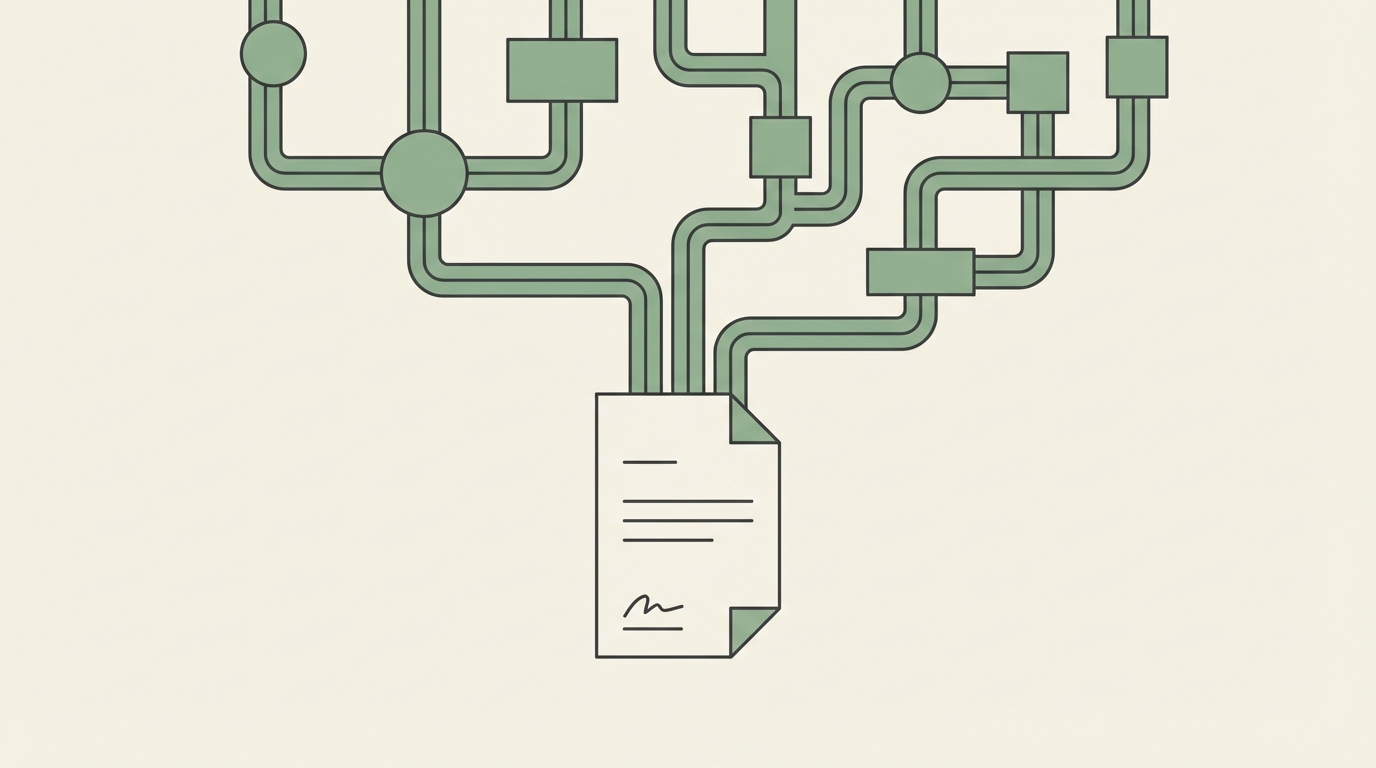
Your SaaS product encodes its intent in three places: the codebase, the documentation, and the people who built it. Code executes. Docs describe. People remember. None of these containers were designed to be queried, tested, or rolled back. And yet, every day, your team makes dozens of consequential decisions — about trial conversions, refunds, churn interventions, feature access, pricing enforcement — that live in exactly these three fragile places.
A decision protocol is the fourth container. It is a named, versioned, explicit record of "when X is true, do Y." It is not code. It is not a doc. It does not live in someone's head. It is a structured artifact that can be read, tested, changed, and traced. This article explains what a decision protocol is, why your current approach to business logic falls short, and how to write your first three.
The Hidden Third System: Decisions That Live Nowhere
In any SaaS company past the early stages, there is an invisible operating system running alongside the product. It consists of the answers to questions that arise every day but are never formally answered in any single place:
- At what point in a trial do we send the upgrade nudge?
- If a customer cancels but has been with us three years, do we offer a discount before they go?
- Who decides when to issue a refund outside the 30-day window?
- Can a free-tier user get access to the analytics export if a sales rep promises it on a call?
These questions get answered — sometimes by a Slack message, sometimes by a buried Notion page, sometimes by a veteran support rep who has been doing it the same way since 2022. As Lenny Rachitsky's operator research has documented repeatedly, scaling SaaS operations does not just mean adding headcount — it means encoding decisions that used to be made by founders or early team members into systems that can execute those decisions consistently at scale.
The problem is that most teams skip the encoding step. They automate the execution without capturing the decision logic. The result is automation that behaves inconsistently, onboarding that takes months instead of weeks, and post-mortems that can never definitively answer "why did the system do that?"
Bain & Company's research on agentic AI and SaaS disruption frames this directly: the SaaS companies best positioned for the agentic era are the ones that have already externalized their decision logic from their people and their code. Those that have not will find that AI agents amplify their inconsistency rather than resolve it.
Defining a Decision Protocol: The Five-Part Anatomy
A decision protocol is not a flowchart. It is not a feature flag. It is not a business rule hidden in a conditional statement. A well-formed decision protocol has five parts:
| Component | What It Captures | Example |
|---|---|---|
| Name | A unique, human-readable identifier for the protocol | trial-conversion-nudge-v2 |
| Trigger | The event or condition that causes the protocol to evaluate | User completes day 10 of a 14-day trial without upgrading |
| Conditions | The facts that must be true for the action to fire | Account has >3 active users AND has exported data at least once |
| Action | The specific, bounded outcome when conditions are met | Send upgrade email template email-003 from account owner's CSM |
| Owner + Version | Who is responsible for this protocol, and which version is active | Revenue Operations, v2, active since 2026-01-15 |
The version and owner fields are not optional bureaucracy. They are the mechanism that makes a protocol auditable. When a protocol produces an unexpected result, you can answer: which version was active at the time of execution? Who approved that version? What changed between v1 and v2?
Without those fields, you have a rule. With them, you have a protocol — something that can be owned, evolved, and defended.
Why If/Else Logic in Code Is Not a Decision Protocol
This is the objection most engineering teams raise first: "We already have this logic. It's in the codebase." And technically, they are right. The if/else is there. The problem is that code does not make a good home for decision logic, for three reasons.
Testability
Decision protocols should be testable by product managers, revenue operations leads, and support team members — not just engineers. When your trial conversion logic lives inside a Python function three layers deep in a billing service, the people who own the decision cannot test it without engineering involvement. Protocol formats separate the logic from the execution, making it inspectable by whoever is responsible for the outcome.
Ownership
Code ownership follows the team that wrote it, not the team that should own the decision. Your pricing tier enforcement logic might live in the product engineering team's codebase, but the decision about who belongs on which tier is owned by Revenue Operations or Finance. Embedding business decisions in code transfers de facto ownership to engineers, who are often not the right people to make or ratify those decisions.
Rollback
When a code change introduces an unintended decision behavior, rolling it back requires a deploy. That deploy takes time, goes through CI/CD, and may bundle other changes. A decision protocol that is versioned and stored separately from the code can be rolled back in seconds — from v3 back to v2 — without touching the application. Research from Tomasz Tunguz on SaaS operational velocity consistently shows that teams with shorter feedback loops between "decision made" and "decision in production" outperform those where business logic changes require engineering cycles.
Five Concrete Protocol Examples from SaaS Operations
Abstract definitions only go so far. Here are five real decision protocols, written in the five-part format, drawn from common SaaS operations:
1. Trial Conversion Nudge
- Name:
trial-conversion-nudge-v2 - Trigger: Day 10 of a 14-day trial without a plan upgrade
- Conditions: Account has 3+ active users AND has completed at least one data export
- Action: Send upgrade email
email-003from assigned CSM; if no CSM assigned, from[email protected] - Owner: Revenue Operations, v2, active 2026-01-15
2. Churn Intervention Offer
- Name:
churn-intervention-annual-v1 - Trigger: Customer clicks "Cancel Subscription" in the billing portal
- Conditions: Account age > 12 months AND current plan is Growth or above AND no active support tickets in past 30 days
- Action: Display offer: 20% discount for 3-month commitment; log offer ID and customer ID to retention dashboard
- Owner: Customer Success, v1, active 2025-11-01
3. Pricing Tier Enforcement
- Name:
feature-export-tier-gate-v3 - Trigger: User requests access to CSV export feature
- Conditions: User's account plan is Starter (does not include export); no override flag set by sales team
- Action: Block export; show upgrade modal
modal-export-upsell-v2 - Owner: Product, v3, active 2025-09-10
4. Feature-Flag Eligibility
- Name:
beta-feature-ai-summary-eligibility-v1 - Trigger: User navigates to the AI Summary feature page
- Conditions: Account is on Pro or Enterprise plan AND account was created before 2026-01-01 AND beta opt-in flag is set
- Action: Grant access; log access grant with user ID and timestamp
- Owner: Engineering (Platform), v1, active 2026-02-01
5. Refund Handling
- Name:
refund-outside-window-v2 - Trigger: Support agent receives refund request > 30 days after charge
- Conditions: Customer has not previously received an out-of-window refund AND refund amount is under $500 AND account is not flagged for fraud review
- Action: Support agent may approve; log approval with agent ID and reason code; no manager approval required under $500
- Owner: Support Operations, v2, active 2025-12-01
The Organizational Cost of Undocumented Protocols
When decision protocols live in people's heads or in buried Slack threads, three costs compound over time.
Onboarding Debt
Every new team member who touches revenue operations, support, or product must reverse-engineer the decisions already being made. This is not onboarding — it is archaeology. The time cost is real, and the error rate during the archaeology phase is high. New CSMs make retention offers that contradict what the system expects. New support reps issue refunds using a policy that was superseded eight months ago.
Incident Post-Mortems That Cannot Conclude
When a customer complains that they were charged incorrectly, or that a cancellation was handled badly, the post-mortem question is always the same: "What decision logic was active at the time?" If the answer is "it's in the code" or "whoever was on support that day," the post-mortem cannot conclude. You cannot fix what you cannot describe. ProfitWell's churn benchmark data repeatedly identifies inconsistent handling of downgrade and cancellation moments as a leading driver of preventable churn — not because teams are making bad decisions, but because they are making different decisions in the same situation.
Conflicting Automations
As SaaS teams add automation tools — CRM workflows, customer success platforms, billing systems, in-app messaging — each tool acquires its own version of the same decision logic. The trial conversion nudge exists in your email tool, your in-app messaging tool, and your CRM workflow, with slightly different conditions in each. Eventually, a customer receives three conflicting nudges in one day, or none at all, because the three systems disagreed about whether the conditions were met.
First Step: Name Your Three Most Consequential Undocumented Decisions
Starting a protocol library sounds like a large project. It is not — if you start with three.
Ask your team this question: "What are the three decisions we make most often that are handled differently depending on who is on shift or which tool fires first?" The answers will be immediate and specific. Those three decisions are your first three protocols. Write them down in the five-part format above. Give them names. Assign owners. Date them.
The act of writing a protocol surfaces the disagreements that already exist. You will discover that the engineering team thinks the trial nudge fires on day 10, while the CSM team thinks it fires on day 12. You will find that the refund policy that lives in the support wiki is not the same as the one coded into the billing system. That discovery is the value — not the document itself, but the conversation it forces.
From there, you can systematically expand the library. The SaaS 50 playbook at memrail.com/saas-50 provides 50 ready-to-use decision protocols covering the most common SaaS operations — a starting library for teams that want to skip the blank-page problem and begin from working examples.
Decision Protocols in the Agentic Era
The urgency of this work has increased sharply as AI agents enter SaaS operations. When a human support rep misapplies a refund policy, the blast radius is one customer. When an AI agent misapplies it — because the policy was never formally written down and the agent inferred it from past examples — the blast radius is every customer the agent touches in a given hour.
Agents need explicit protocols to operate safely. A protocol that has a name, conditions, action, and owner is something an agent can be given as a clear instruction. A decision that lives in human institutional memory cannot be reliably transmitted to an automated system. This is the deeper reason that decision protocols matter in 2026: not just for human consistency, but as the interface between your business logic and any automated system — AI or otherwise — that executes on your behalf.
The SaaS teams who encode their decision protocols now are building the foundation that makes agentic automation safe. Those who skip this step will find that their agents are fast, capable, and consistently wrong in ways that are hard to diagnose and hard to fix.