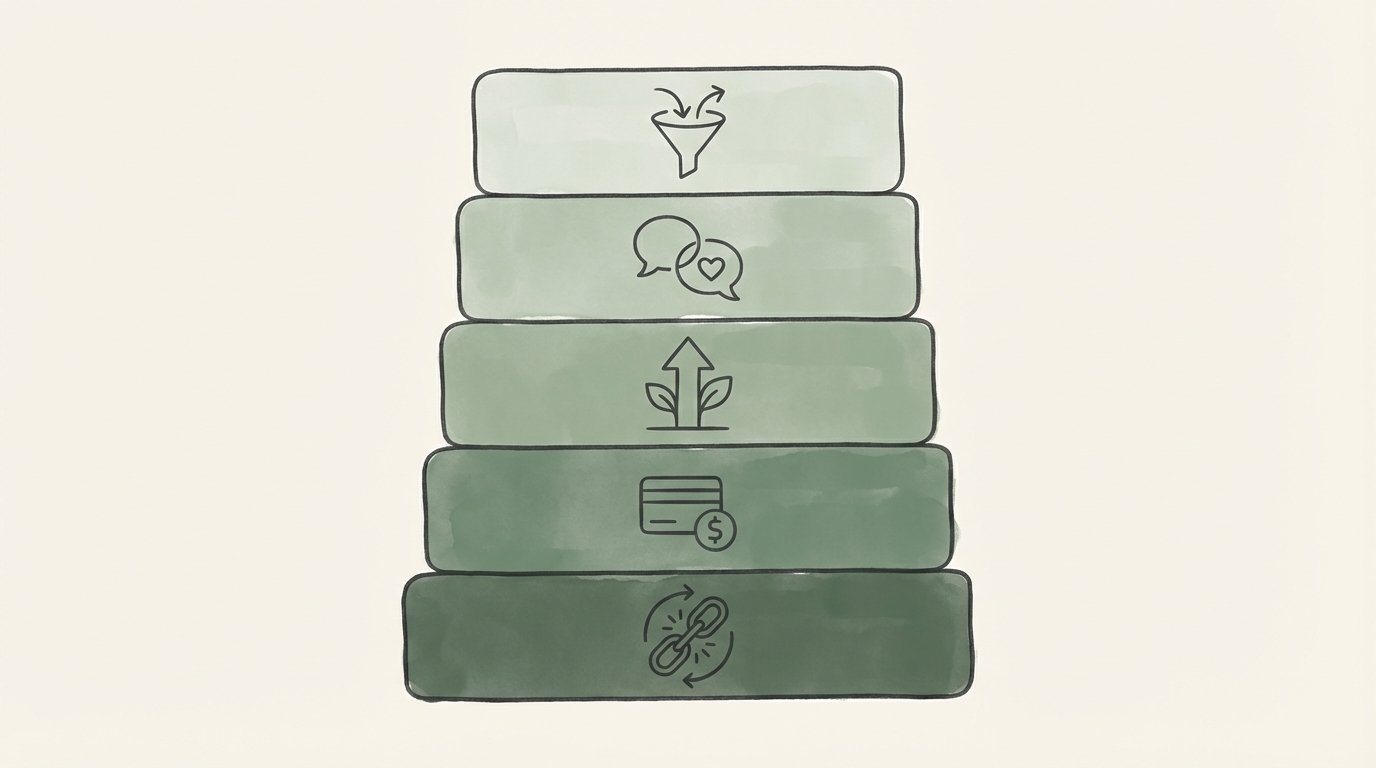
Every SaaS company has a customer lifecycle. Few have a decision stack that governs it. The lifecycle itself is well understood -- users sign up, activate, engage, expand, pay, and sometimes leave. What is not well understood is the set of decisions that must fire at each stage to keep the lifecycle moving forward, and what happens when those decisions are absent, inconsistent, or buried in code that no one on the revenue team can inspect.
This article maps the SaaS customer lifecycle as a decision stack: a structured layer of explicit, named, governed decisions that correspond to each stage of the customer journey. The concept is not theoretical. SaaStr's annual benchmarks consistently show that top-quartile SaaS companies have higher automation rates at lifecycle transitions -- not because they have more tools, but because they have clearer decision logic at each touchpoint. The companies that treat lifecycle automation as a tooling problem end up with fragmented, conflicting automations. The companies that treat it as a decision problem build systems that scale.
What a Decision Stack Is (and Is Not)
A decision stack is the ordered set of decision protocols that govern a complete business process. Each protocol in the stack is a named, versioned rule with an explicit trigger, conditions, action, and owner. The stack defines the complete set of decisions that must fire for the process to work correctly -- and, critically, it makes the gaps visible.
A decision stack is not an automation workflow. Automation workflows describe the mechanics of execution: "send this email," "update this field," "trigger this webhook." A decision stack describes the logic that determines whether and when those automations should fire. The distinction matters because most SaaS teams have robust automation tooling -- marketing automation platforms, CRM workflow builders, billing system hooks -- but fragile decision logic. The automations fire, but they fire at the wrong time, for the wrong cohort, or in contradiction with another automation.
A decision stack is also not a customer journey map. Journey maps describe the customer's experience. Decision stacks describe the company's response. They are complementary artifacts, but the decision stack is the one that determines operational outcomes.
Stage 1: Acquire and Activate
The first lifecycle stage encompasses everything from initial signup through the moment the user reaches the "aha moment" -- the activation event that predicts long-term retention. Lenny Rachitsky's research on activation metrics has shown that companies with clearly defined activation events retain users at two to three times the rate of companies that treat all new signups identically.
The decisions that must fire at this stage are:
| Decision | Required Inputs | What Happens When Skipped |
|---|---|---|
| Trial qualification | Signup source, company size, domain, declared use case | Unqualified leads consume trial resources; sales team wastes time on poor-fit accounts |
| Onboarding path selection | User role, company size, declared goal, product tier | All users receive the same onboarding sequence regardless of intent; activation rate drops |
| Activation nudge timing | Days since signup, key actions completed, engagement velocity | Nudges fire too early (annoying), too late (user has already disengaged), or not at all |
| Sales-assist handoff | Account score, engagement signals, trial day, company size threshold | High-value prospects go uncontacted; low-value accounts get unnecessary sales touches |
Each of these decisions requires specific input data and produces a specific action. When any decision is missing from the stack, the corresponding customer touchpoint becomes either random (depends on who is on shift) or absent (no one realizes it should happen). The activation stage is where most SaaS companies have the widest gap between the decisions they think they are making and the decisions that are actually firing consistently.
Stage 2: Engage and Retain
Once a user has activated, the lifecycle shifts to engagement and retention. This stage runs for the entire duration of the customer relationship and encompasses the decisions that determine whether a customer remains active, becomes at-risk, or silently disengages. ProfitWell's State of Subscriptions data shows that the median SaaS company loses 5-7% of customers monthly to voluntary churn alone -- and a significant portion of that churn is preceded by detectable engagement decline that triggered no intervention.
The key decisions at this stage:
| Decision | Required Inputs | What Happens When Skipped |
|---|---|---|
| Health score classification | Login frequency, feature usage depth, support ticket volume, NPS or CSAT signals | At-risk accounts are invisible until they cancel; CSMs react instead of intervene |
| At-risk intervention trigger | Health score decline rate, days since last login, support sentiment trend | Declining accounts receive no proactive outreach; the first touchpoint is the cancellation page |
| Feature adoption prompt | Features available on plan, features not yet used, peer usage benchmarks | Customers pay for features they never discover; perceived value decreases over time |
| QBR or check-in eligibility | Account value, renewal date proximity, health trajectory, CSM capacity | High-value accounts get no strategic touchpoint; renewal conversations happen cold |
The engagement stage is where decision consistency matters most. A customer whose health score drops should trigger the same intervention sequence regardless of which CSM owns the account, which time zone the customer is in, or whether it is a holiday week. When engagement decisions are not governed by explicit protocols, intervention quality becomes a function of individual CSM attentiveness rather than systematic operations.
Stage 3: Expand and Monetize
Expansion revenue -- upgrades, seat additions, cross-sells, and usage-based growth -- is the compounding engine of SaaS economics. Tomasz Tunguz's research on SaaS growth has documented repeatedly that the most capital-efficient SaaS companies generate 30-40% of new revenue from existing customers. But expansion does not happen passively. It requires decisions that identify expansion readiness, select the right offer, and execute the touchpoint at the right moment.
| Decision | Required Inputs | What Happens When Skipped |
|---|---|---|
| Expansion readiness signal | Usage approaching plan limits, team size growth, feature gate hits | Expansion opportunities are identified only when the customer hits a hard limit and complains |
| Upsell offer selection | Current plan, usage patterns, peer cohort behavior, available plans | Generic upgrade prompts that do not match the customer's actual usage or needs |
| Seat addition prompt | Active seats vs. licensed seats, invitation patterns, team growth signals | Multi-seat accounts under-license; revenue is left on the table |
| Usage-based billing threshold alert | Current usage, billing period remaining, projected overage | Customers are surprised by overage charges; trust erodes; disputes increase |
The expand-and-monetize stage is where the decision stack directly affects revenue. Every missing or poorly timed expansion decision is revenue that is either left on the table or captured in a way that damages the customer relationship. The best SaaS operators govern expansion decisions with the same rigor they apply to product releases -- because a poorly timed upsell is as damaging as a poorly timed feature launch.
Stage 4: Billing and Revenue
Billing decisions are the most consequential and least glamorous layer of the SaaS lifecycle. They determine when customers are charged, how disputes are handled, what happens when a payment fails, and how credits and refunds are processed. ProfitWell's data consistently shows that involuntary churn -- churn caused by failed payments rather than deliberate cancellation -- accounts for 20-40% of total churn in the median SaaS company, and most of it is recoverable with the right decisions in place.
| Decision | Required Inputs | What Happens When Skipped |
|---|---|---|
| Dunning sequence selection | Payment failure reason code, customer tenure, account value, prior recovery attempts | All failed payments receive the same generic retry sequence; recovery rates stay flat |
| Refund approval routing | Refund amount, customer history, time since charge, refund reason | Refunds are either over-approved (revenue loss) or under-approved (customer friction) |
| Plan change proration | Current plan, new plan, days remaining in billing period, billing model | Proration errors cause incorrect charges; support tickets spike at upgrade and downgrade moments |
| Credit issuance authorization | Incident severity, service-level agreement terms, customer tier, prior credits | Credits are issued inconsistently; some customers get generous make-goods while similar cases get nothing |
Billing decisions have a distinctive property: they are almost always subject to audit. When a customer disputes a charge, a regulator reviews a complaint, or an internal review examines revenue recognition, the billing decision must be explainable and defensible. This is where governed lifecycle automation meets compliance -- and where the absence of explicit decision protocols creates the most regulatory and financial exposure.
Stage 5: Recover and Win Back
The final lifecycle stage addresses customers who have churned or are in the final stages of leaving. Recovery decisions determine whether a departing customer receives a retention offer, how that offer is constructed, and whether churned customers are candidates for win-back campaigns at a later date.
| Decision | Required Inputs | What Happens When Skipped |
|---|---|---|
| Cancellation offer eligibility | Account tenure, lifetime value, cancellation reason, prior offers received | Every cancellation gets the same offer (or no offer); high-value saves are missed |
| Cancellation reason routing | Stated reason, product area, support history, competitor mentions | Product team has no structured feedback loop from churned customers |
| Win-back campaign eligibility | Time since churn, original churn reason, product changes since departure | Churned customers are either never re-contacted or contacted too soon with irrelevant offers |
| Account data retention | Data retention policy, regulatory requirements, customer data deletion requests | Compliance risk from retaining data too long; win-back risk from deleting data too soon |
Recovery is the stage where decision quality has the most direct, measurable financial impact. A well-constructed cancellation save offer -- targeted to the right customer, with the right value, at the right moment -- can recover 10-15% of voluntary churn. A generic discount offered indiscriminately trains customers to cancel in order to receive discounts and erodes margin. The difference between these outcomes is the decision protocol, not the automation tool.
What Governed Lifecycle Automation Looks Like
The five lifecycle stages above contain roughly twenty core decisions. Most SaaS companies have automation in place for some of them, but the automation is typically scattered across multiple systems -- the CRM handles some, the billing platform handles others, the marketing automation tool handles a few more -- with no single layer that governs which decisions are active, what version of each decision is in production, or how decisions interact with each other.
Governed lifecycle automation is the practice of managing these decisions as a single, coherent stack. Concretely, this means:
- Every lifecycle decision has a name, a version, and an owner. When a decision produces an unexpected outcome, you can identify which version was active and who is responsible for it.
- Decisions are testable independently of the tools that execute them. The logic that determines "is this customer eligible for a retention offer?" is separated from the email tool that sends the offer. The logic can be tested, reviewed, and changed without touching the execution layer.
- Changes to lifecycle decisions go through a safe rollout process. A new cancellation save offer is not deployed to all traffic immediately. It is shadow-tested against recent cancellation events, canary-deployed to a small cohort, and promoted only after validation.
- The complete stack is visible in one place. Product, revenue operations, customer success, and engineering can all see which decisions are active at each lifecycle stage, what their conditions are, and when they were last changed.
The SaaS 50 playbook provides a starting library of fifty decision protocols mapped to these five lifecycle stages. For teams that want to move from scattered automation to a governed decision stack, the playbook eliminates the blank-page problem and provides working templates for each stage.
The Cost of a Missing Decision
The value of a decision stack is most visible in its absence. Every missing lifecycle decision has a specific, quantifiable cost:
- A missing activation nudge costs the conversion rate of users who signed up with intent but were never guided to the activation event.
- A missing at-risk intervention costs the lifetime value of customers who disengaged gradually and were never contacted until they cancelled.
- A missing expansion signal costs the expansion revenue from customers who were ready to upgrade but were never presented with an offer.
- A missing dunning optimization costs the involuntary churn that was recoverable with the right retry strategy but received a generic treatment instead.
- A missing cancellation save protocol costs the save rate on departing customers who would have responded to a targeted offer.
These costs are not hypothetical. They are measurable in the data that SaaS companies already have. The decision stack framework provides a systematic way to identify which decisions are missing, prioritize them by revenue impact, and implement them with the governance that ensures they fire consistently.
Building Your First Decision Stack
Start with the lifecycle stage that has the highest visible pain. For most SaaS companies, that is either Stage 2 (Engage and Retain) or Stage 5 (Recover and Win Back), because the symptoms of missing decisions at these stages are the most directly observable: rising churn, inconsistent retention offers, and CSMs operating without a playbook.
For the chosen stage, enumerate the decisions that should fire. For each decision, document the trigger, the required inputs, the conditions, the action, and the owner. This exercise alone -- before any automation is built -- will surface the gaps and inconsistencies that are driving operational variance.
Then, implement the decisions as governed protocols: named, versioned, testable, and safe to change. The tools you use for execution matter less than the decision layer that governs when and how those tools fire. A SaaS company with five well-governed lifecycle decisions will outperform one with fifty ungoverned automations every time, because consistency at key moments beats coverage of marginal ones.